
How Martiqo works
Last updated 7 November 2026
Martiqo is a marketplace where independent sellers offer products, food, services and software in their own shops. You buy from the seller, not from Martiqo. Placing an order does not charge you: the seller first confirms the terms, you accept them, and only then do you pay — by card, through Stripe, straight to the seller.
In 20 seconds: find a listing → place the order (nothing is charged) → the seller confirms price, shipping and delivery → you accept → you see the exact total and pay through Stripe → the seller delivers → you confirm receipt. Sellers run their own shops, are the merchant for every sale and receive the money in their own Stripe account; Martiqo provides the marketplace and takes a small flat fee per payment.
Who does what
Martiqo is a technology intermediary: it provides the shops, the search, the order workflow and the messaging between buyer and seller. The contract of sale is between you and the seller. The seller is the Merchant of Record for every sale — responsible for the listing, the price, delivery, taxes, invoices and your legal rights as a buyer. Online payments are processed by Stripe on the seller's own connected Stripe account; Martiqo never holds or routes the money.
| Participant | Responsible for | Not responsible for |
|---|---|---|
| Buyer | Choosing a listing, placing the order, giving a correct delivery address, accepting the terms and paying the agreed total. | Paying just because an order was placed — nothing is due until the terms are agreed. |
| Seller | Accurate listings and prices, confirming the terms, delivery, VAT and other taxes, invoices, returns and warranty obligations under the law that applies to them. | — |
| Martiqo | Shops and listings, search, the order workflow, messages, notifications, fee collection and the documentation you are reading. | Being the seller, holding your money, shipping, refunds or deciding disputes. |
| Stripe | Processing the card payment, verifying the seller's identity and paying the seller out under Stripe's terms. | Being a party to the sale. |
Note
Accounts and shops. On Martiqo you buy and sell through shops, not through your account: every shop can buy, selling is switched on per shop, and one account can own several shops (a personal one, a company one, a second brand), each with its own invoice identity, orders, statistics and reputation. This is different from other marketplaces — read Accounts and shops first if it is new to you.
Sellers can be individuals or registered businesses; the type is declared when the seller creates their invoice identity and is shown on orders and invoices. See the Terms of Service for the legal framework.
What you find on Martiqo
Every listing belongs to one of four categories. They are browsed, ordered and paid the same way; what differs is what you should check before ordering.
| Category | What it covers | Worth checking before you order |
|---|---|---|
| Products | Physical goods, including products sold in several sizes or colours (variants). | Options, stock, where it ships from, delivery cost and time. |
| Food | Prepared food and food products. | Where the seller delivers or hands over, when, and any product details that matter to you. |
| Services | Services offered by individuals or businesses, local or remote. | What exactly is included, where it is performed and when. |
| Software | Digital software products. | Licence scope, how it is delivered or activated, and support. |
You can browse shops and listings and read a shop's description and contact details without an account. Ordering needs an account — and with an account you can also post a request for something you cannot find, so that sellers can respond to it.
How an order works
- Find a listing. Search Martiqo or open a shop. Prices are shown before VAT; the currency selector converts them for display, the payment is made in the seller's currency.
- Place the order — no payment. Choose the options and quantity, then Buy now or add to the cart and Checkout. You confirm the delivery address and a phone number for the courier and can add a note. The seller is notified. Nothing is charged.
- The seller confirms the terms. The seller reviews the order and sets the final prices, adds shipping if needed, commits to a delivery date and proposes the payment schedule (usually one full payment; an advance plus a final payment is possible).
- You accept or counter-propose. You can accept, propose changes or cancel. The seller can accept your proposal or adjust again. Each side has 7 days to respond, or the order expires with nothing paid.
- You pay. Once the terms are agreed the order waits for the first payment. You see the exact amount — VAT included when it applies — and pay by card on a Stripe Checkout page that belongs to the seller's Stripe account.
- The seller delivers. The seller ships (registering the shipment and tracking on the order) or performs the service. You can message the seller on the order page throughout.
- Completed. You confirm receipt; if you do nothing, the order completes by itself once the delivery window has passed (2× the promised delivery time). Until then you can open a dispute.
The key distinction: ordering is not paying
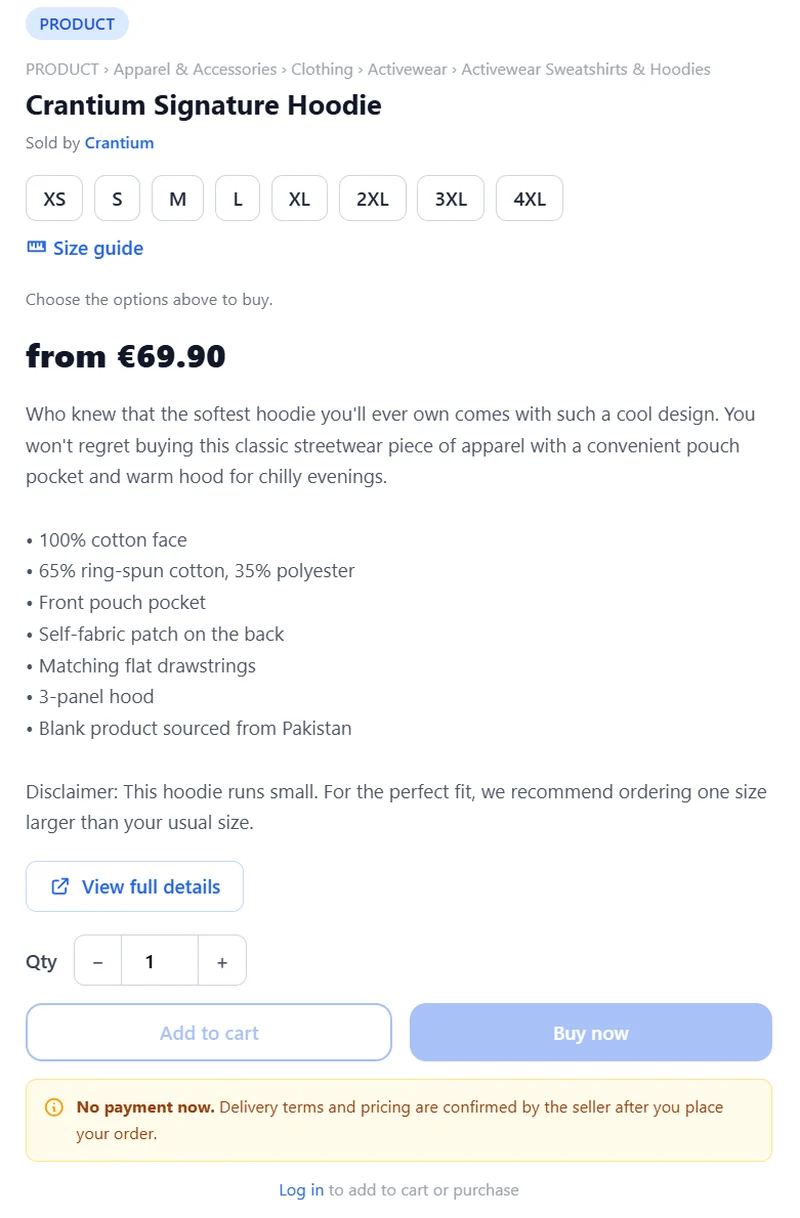
On most online shops, clicking "buy" charges your card. On Martiqo, placing an order is a request. The seller confirms what will be delivered, when, for how much and how it is paid; you accept; only then does a payment exist. Before the first payment, either side can cancel free of charge and no money has moved.
Example. You order a lamp listed at €90. The seller confirms it is in stock, adds €8 shipping to your country and commits to deliver within 7 days of payment. You accept. You now see €98 (plus VAT if the seller is VAT-registered and it applies to you), pay it by card, and the seller ships. The amounts are illustrative, not a quote.
Where the money goes
- Your card payment is processed by Stripe on the seller's connected Stripe account. The money lands in the seller's Stripe balance and Stripe pays it out to the seller on Stripe's own schedule — Martiqo does not hold it, so there is no escrow.
- Martiqo's platform fee is taken from that payment as a Stripe application fee. It is paid by the seller; you never pay a Martiqo fee on top of the price.
- Stripe's card processing fee is charged by Stripe to the seller, like in any online shop.
- When the seller is VAT-registered, Stripe calculates the VAT for your address and VAT status and adds it to the total you see before paying. Business buyers with a valid EU VAT number are not charged VAT where reverse charge applies. See VAT on your sales.
- Refunds are made by the seller (from their Stripe account or otherwise). Martiqo records on the order that the seller has returned the money and asks you to confirm it.
What Martiqo charges
Sellers pay a flat platform fee per payment, decided by the amount of that payment. It is never a percentage of the sale:
| Payment amount | Platform fee |
|---|---|
| Up to €100 (inclusive) | €1.00 |
| Above €100, up to €500 (inclusive) | €5.00 |
| Above €500 | €10.00 |
"Per payment" matters when an order is paid in parts: a €600 order paid as one payment costs the seller €10.00; the same order paid as a €300 advance and a €300 final payment costs €5.00 + €5.00. Shipping lines count towards the payment amount. Sellers also pay a yearly subscription per selling shop and, where they use them, Stripe's VAT calculation and invoicing features at cost — see the seller journey and how this compares with other marketplaces.
Buying from several sellers
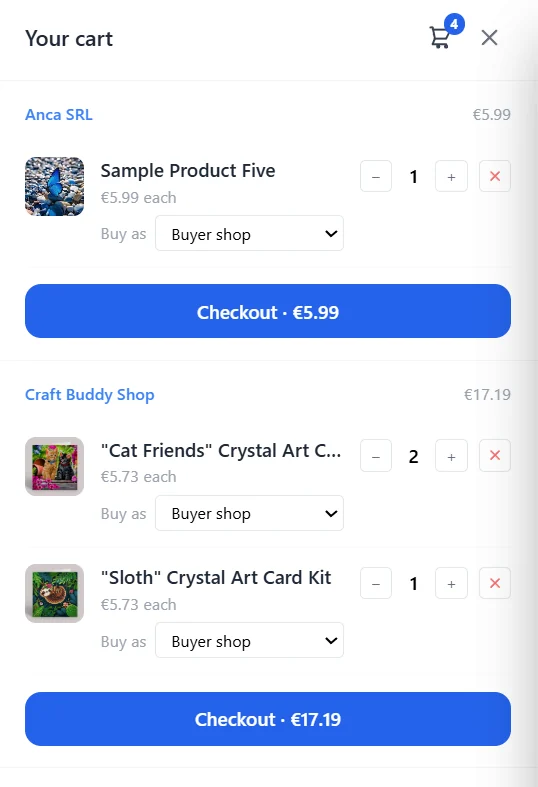
Your cart groups items by seller, and each group has its own Checkout button. Every seller gets a separate order: separate terms, separate payments, separate shipping and a separate invoice. There is no combined payment across sellers, because each payment goes to that seller's own Stripe account.
Time limits that keep orders moving
Orders do not stay open forever. These limits are set by Martiqo and shown on the order page:
- Seller response
- 7 days to set the terms of a new order, or it expires.
- Buyer response
- 7 days to accept or counter-propose, or it expires.
- Payment
- 3 days to pay a requested payment, or the order expires.
- Delivery window
- 2× the promised delivery time, then the order completes by itself.
- Dispute
- A 7 days message window, then each side records the outcome.
An expired or cancelled order before payment costs nothing. Nothing on Martiqo charges you automatically.
When something goes wrong
- Before payment — either side can cancel the order; no money has moved.
- After payment — if the buyer cancels, the advance already paid stays with the seller; if the seller cancels, the seller must return the money to the buyer (outside Martiqo, e.g. a Stripe refund) and the buyer confirms on the order that it arrived.
- Disputes — while an order is in progress or shipped, either side can open a dispute on the order page. It opens a 7 days message thread; afterwards each side records whether it was resolved. Martiqo does not hold funds and does not decide disputes; the outcome is recorded on both sides' order history.
- Your legal rights — returns, withdrawal and warranty rights depend on the seller's type and your country and are owed to you by the seller.
What Martiqo does — and does not — promise
| Martiqo provides | Martiqo does not guarantee |
|---|---|
| Public shop pages and listing search | That a seller has stock or will accept an order |
| An order workflow in which terms are agreed before payment | A delivery date — the seller commits to one per order |
| Card payments through Stripe to the seller's account | Holding your money until delivery (there is no escrow) |
| Messages, notifications and a record of every order | Refunds — they come from the seller |
| Flat, published fees for sellers | That a seller can be paid out in every country — Stripe decides eligibility |
Frequently asked questions
Am I charged when I click "Buy now"? No. "Buy now" places the order for that product; the seller confirms the terms and you pay afterwards, if you accept them.
Who am I buying from? From the seller shown on the listing and the order. Martiqo is not a reseller.
Do I need an account? To look around, no. To order, yes — plus a shop on your account (a buyer-only shop has no subscription fee) with an invoice identity, because your invoicing details and delivery address come from it. See Accounts and shops.
Can individuals sell? Yes. Individuals and businesses sell under their own name and remain responsible for taxes and legal obligations; Stripe verifies every seller's identity.
Does Martiqo ship? No. The seller ships or performs the service as agreed on the order.
In which currency do I pay? In the seller's Stripe currency. Prices are converted for display only; the order page shows the amount that will be charged.
Next steps
- Want to buy? Read the buyer journey.
- Want to sell? Read the seller journey.
- Already selling? See VAT on your sales, Invoices issued by Stripe and the Buy on Martiqo button for your own website.